Composite decking in Australian heat and UV
Capped boards have improved on first-generation wood-plastic composites, but Australian heat, UV, expansion and tropical mould still decide whether a composite deck is a relief or a regret.

Composite decking arrives in Australia with a promise that sounds like a holiday: no oiling, no splinters, no silvering, no Saturday spent on the knees with a deck brush. Some of that promise is real. A modern capped board can be a civilised wearing surface. Some of the promise was written for a milder sun than the one that sits on a western courtyard in February. Heat, ultraviolet light, thermal expansion, scratch and, in the wet tropics, mould — these are the conditions that sort a good composite job from a shiny regret.
This is not an anti-composite essay. It is a climate essay. If you are choosing decking boards in this country, you need to know what a polymer-and-fibre plank does at fifty-something degrees on the surface, how it grows along its length, and why a manufacturer’s photograph is not a specification.
A commercial manufacturer site such as Trex is a product page. It can show colours, profiles and a brand story. It is not a substitute for an Australian spanning table, a local installation guide, or a certifier’s reading of the National Construction Code. Treat it as a catalogue, not as AS 1684.
What “composite” is, and what the first generation taught us
The first wood-plastic composites that arrived here were a mix of timber fibre and polyethylene or polypropylene, extruded into a board that wanted to look like stained pine. They faded. They stained. They grew a biofilm in the shade. They could swell at the cut end. They got hot. Some of them became a case study in why a new category needs a second generation.
Capped boards — a wear layer of polymer over a composite core — are the industry’s answer to those early failures. The cap is there to keep stains out, to slow fade, and to give the embossed grain something tougher than raw fibre to live in. Many of the boards now sold into Australian yards are capped. Some cheaper lines still behave like the first generation with a better brochure. Ask which one you are buying. Look at a cut end. If the sales story is only “WPC”, ask whether there is a cap, what the core is, and whether the local distributor has an installation supplement for this climate.
You will see the look in photographs of wood-plastic composite decking: an even colour, a repeated grain, a cleanliness that timber reaches only after a restoration. That evenness is the aesthetic. It is also the tell. Timber is a tree. Composite is a product. Both can be designed well. They should not be specified as if they were the same sentence.
Heat, the conversation people have in January
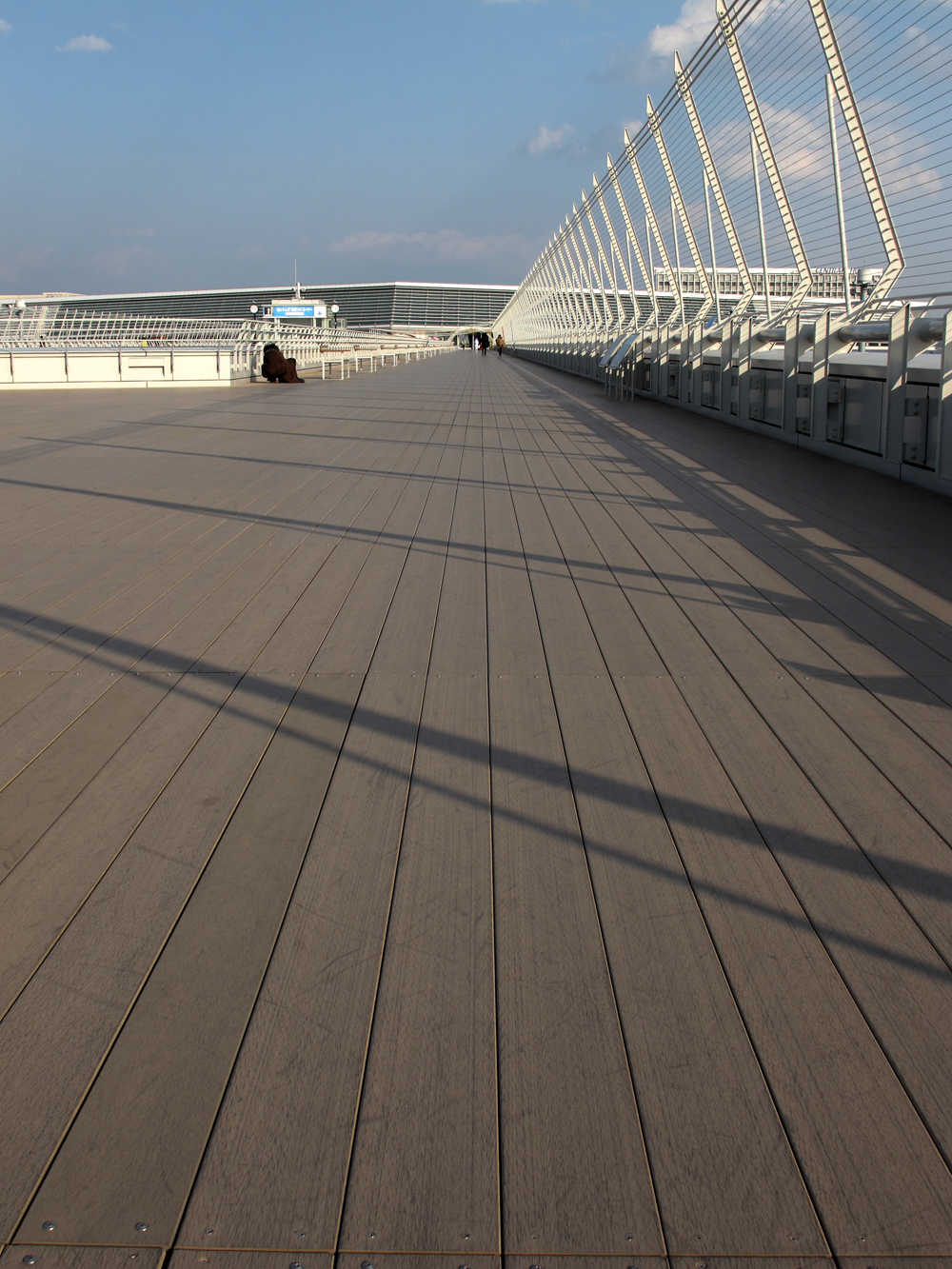
Australian summer does not warm a deck. It loads it. Dark boards in full sun become a radiant surface. Composite, especially darker colours, can sit hotter underfoot than a weathered, pale hardwood. Owners who grew up on silver spotted gum are surprised. Children who run to the pool are not theoretical users; they are the brief.
Heat is not only comfort. It is movement and it is furniture. Rubber feet mark. Dark metal frames cook the cap. A thin outdoor rug becomes a greenhouse. If the deck is a north-western box with no pergola and a charcoal board, you have designed a frypan and called it low maintenance.
Practical responses, in order of usefulness:
- Choose a lighter colour if the deck is a barefoot route.
- Put shade over the sitting zone — a pergola, a sail you actually engineer, a tree that is allowed to exist.
- Leave airflow under the boards. A closed, foil-wrapped undercroft on a hot slab cooks the system from both sides.
- Do not test the hottest board at 2pm with a client in leather shoes and then declare the surface fine.
Timber gets hot too. Anyone who has stood on new dark merbau knows that. The difference is that composite is often sold as the escape from timber’s inconveniences, and heat is an inconvenience the brochure underplays.
Expansion: the long direction is the honest one
Seasoned hardwood moves across the grain more than along it. Composite moves along its length in a way that surprises people who learned to deck on eucalypts. A long run, butted neatly to a sliding-door threshold or a metal angle, will announce the physics. Boards grow in the heat. They shrink in a cold snap. Hidden clips that hold too tightly, or not tightly enough, turn that movement into a wave, a squeak, or a screw that elongates its hole.
Manufacturer gap tables exist because of this. Use the local ones. Do not copy a gap from a hardwood job and congratulate yourself on consistency. End-to-end joins need the specified break. Picture-frame borders need a plan for the long inner field pushing against them. Stairs need a detail that does not trap a growing tread against a stringer.
Metal framing, increasingly used under composite, has its own expansion and a different fastener logic. Timber framing is familiar and works if you size it and ventilate it. Either way, the board is not a ceramic tile. It is a long, thermally active extrusion.
Colour fade and the Australian UV file
Ultraviolet light here is not a gentle ageing. It is a stripping force. Early composites faded toward a chalky, uneven grey, especially on the sun face of a board while the gap stayed darker. Capping improved that story. It did not repeal photochemistry. Expect a shift. Expect the shift to be more visible if you chose a saturated colour. Expect a rug or a pot to leave a shadow for a while if you move it after a hard summer.
Fade is not always a warranty event. Read the document. Many warranties describe a degree of change as normal. A designer who promised “this colour forever” has promised something the polymer cannot sign.
If colour hold is the reason you left timber, be precise. You are buying slower change and easier cleaning, not a frozen sample. For the cleaning itself — biofilm, sunscreen, tannin from overhanging trees — see cleaning composite and timber. The broom still exists. Low maintenance is not no maintenance.
Scratch, scuff and the honesty of a cap
A cap can be tough and still mark. Furniture dragged after a party, a sandstone grit on a sliding chair, a dog that has been at the beach — these write on polymer the way they write on oiled timber, only the repair is different. You cannot sand a thin cap as if it were a 21-millimetre hardwood board. Some systems offer a repair stick or a replacement board. Some owners learn to live with a patina of scuffs and call it the house.
If the household is hard on floors, ask whether a through-colour or a thicker wear layer exists in the range, and whether a single board can be lifted from the clip system. A composite deck that cannot surrender one damaged plank is a laminate floor in the weather.
Mould, biofilm and the wet tropics
The marketing climate for composite is often a dry temperate suburb. The Australian climate includes Cairns, Darwin, a Brisbane undercroft that never sees sun, and a south-facing deck under a dripping Monstera. In those places a biofilm will grow on anything that holds a bit of dust and a bit of water — polymer included. Capping reduces the fibre at the surface, which helps. It does not make the board sterile.
Shade plus warmth plus organic fallout is a mould factory. You will still wash. You will still keep gaps clear. You will still regret a barely sloped deck that holds a film of water after every storm. Composite can be the right wearing surface in the tropics — splinter-free, less tannin than new merbau — if you budget for cleaning and you detail for drainage. It is the wrong surface if the pitch was “never think about it again”.
Coastal air, salt and the part that is not plastic
On a headland the wearing board is only half the job. Salt will not eat a polymer cap the way it eats a cheap coated screw, but the screws, clips and joist hangers remain metal. Coastal decks, salt and corrosion still govern the frame. Specify stainless. Keep the undercroft washable. Do not treat composite as a corrosion strategy. It is a surface strategy.
Composite can be a relief at the coast precisely because you are not trying to keep an oil film on a face that salt and sun strip together. That is a real advantage. Claim it accurately.
How to specify without becoming a brand ambassador
Write the performance, then name a product that meets it.
- Capped board, not an unnamed WPC mix, unless you have seen a ten-year-old local example you accept.
- Colour in the light-to-mid range if the deck is a summer barefoot path.
- A published spanning figure for the actual joist spacing, treated as typical until the local guide and the engineer agree.
- A clip or fastener system the manufacturer will warrant in this climate, with a replacement-board method.
- Ventilation, fall and gaps written on the drawing, not left to “standard practice”.
- A frame material and treatment that match the hazard, not the colour chart.
Keep the manufacturer site in its place. It is useful. It is sponsored information in the commercial sense even when you are only looking up a profile. The journal’s job is to say that out loud so a product page does not quietly become the standard.
Composite in Australian heat is neither a scam nor a miracle. It is a polymer system asked to live in a hard light. If you design for the heat, the expansion and the broom, it can be a calm outdoor floor. If you design for the brochure, January will write the correction.
Questions readers send
- Do composite boards get too hot for bare feet?
- Dark composites in full Australian sun can be uncomfortably hot — sometimes hotter than a weathered pale hardwood. Colour, shade and airflow matter more than the brand name. If the deck is a barefoot path to a pool at midday, choose a light colour, add shade, or accept that people will wait until late afternoon.
- How much gap should I leave for expansion?
- Follow the manufacturer’s Australian or local supplement, not a northern-hemisphere brochure used as folklore. Composite expands along its length more than seasoned hardwood. Long runs, tight abutments and metal framing make the movement visible. End-to-end gaps and breakers are detailing, not optional neatness.
- Will composite fade and scratch in this climate?
- All outdoor composites change. Capped boards fade more slowly and clean more easily than early wood-plastic mixes, but UV will still shift colour and grit will still mark the cap. Scratch is a furniture-and-grit problem. Fade is a sun problem. Neither is solved by a warranty paragraph you have not read.
- Is composite better than timber near the coast?
- The wearing surface often copes with salt better than an unoiled hardwood face. The frame, fasteners and connectors still corrode. Specify stainless and a drained, ventilated structure. Composite does not make a coastal deck maintenance-free; it changes which surface you are maintaining.